
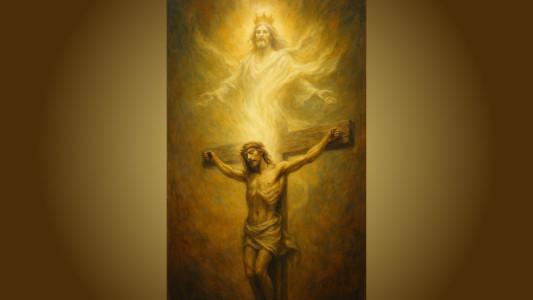
Author: Sławomir Żydenko
Who Was Jesus?
To talk about the death of Jesus, we must go back to the beginning of the Universe. According to The Urantia Book, the Universe was created by God, and no modern religion denies this. According to science, the Universe and life arose on their own, which is merely a theory because what evidence is there that the Universe arose on its own, without any intelligence—the first cause of all events? Ultimately, it’s more sensible that an Intelligent Being creates a thing, such as the material Universe, rather than a thing creating an Intelligent Being, isn’t it? If things could ever create intelligent beings, it would be happening now. A car would create a driver, an airplane a pilot, and a shoe a shoemaker. At any rate, religions do not dispute that the Universe was created by God, so let’s stay with that thesis.
Read more about the search for God in the Universe:
The Universe is immense. God does not personally govern the Universe but divided it into segments, into administrative units. One of these administrative units is ruled by Michael of Nebadon. We live in the administrative unit of the Universe called Nebadon.
More about Nebadon in my article:
https://urantia.online/en/urantia-is-earth-nebadon-is-fragment-of-the-milky-way/
Michael of Nebadon is the being who incarnated on Earth and is known here as Jesus of Nazareth.
Why Did Jesus Have to Die?
Before coming into the world, Jesus had a dual mission. After completing the construction of Nebadon, his mission was to gain full sovereignty over this part of the Universe. To achieve this, he had to fulfill one condition: live the life of a mortal. He had to incarnate as a mortal and live a life from beginning to end to know and understand the people he himself had created. A good ruler must understand every inhabitant of his kingdom to be able to care for them. And here we already have the answer to the question of why Jesus had to die. If he had to experience the fullness of life from beginning to end, then he also had to experience death.
What Determined the Choice of Palestine for Jesus’ Mission?
The second element of Jesus’ mission was to convey a new concept of God to humanity. The new concept of God according to Jesus was that God is the Father, and we are all brothers.
To convey this concept, he had to go to a place in the world where the concept of one God was already crystallized. It would have been rather difficult for him to introduce the concept of a Universal God to people who believed in many gods or shamanism. It would have been too great an ideological leap. The best place for this purpose turned out to be Palestine. There, the concept of one God was crystallized, and on that concept, he built a new concept of God. So, onto the concept of God Yahweh, he built the concept of God the Father.
Yahweh was essentially the God of the Israelites alone. To the concept of the national God of the Israelites, he added the concept of the Universal God, the Father of all beings on Earth and beyond, and in the Universe.
According to The Urantia Book, we are not alone in the Universe; there are many such worlds. Science is also slowly leaning in that direction—discoveries of new planets are now commonplace.
Who is Directly Guilty of Jesus’ Death?
Jesus came to Earth to experience mortal life and announce the new idea of God. For this purpose, he chose Palestine. True, the concept of one God existed there, but unfortunately, there were also Jewish priests whose financial interests Jesus disrupted. The turning point that ultimately decided that Jesus would be sentenced to death was entering the temple and driving out the merchants.
Enormous amounts of money flowed there. Imagine that for the Passover feast, one had to sacrifice an animal, usually a sheep or a goat. Normally, one could not come with one’s own animal and sacrifice it; one had to buy the animal from the temple. The problem was that the temple animal was many times more expensive than a regular one, and specific people profited from the price difference. He destroyed this business for them and thus risked death.
Why did Jesus have to do this? First, the merchants defiled the temple, and second, the bloody Passover did not fit the new concept of a loving God the Father. The bloody Passover was a symbol of the old concept of a vengeful God Yahweh.
It must be considered that expelling the merchants from the temple was an act of extraordinary courage by Jesus, as he was likely aware of what he was doing and whom he was angering.
To finally answer the question of who is the main culprit of Jesus’ death, I will use a quote:
“184:1.1 (1978.4) Annas, enriched by the temple revenues, his son-in-law the acting high priest, and with his relations to the Roman authorities, was indeed the most powerful single individual in all Jewry. He was a suave and politic planner and plotter. He desired to direct the matter of disposing of Jesus; he feared to trust such an important undertaking wholly to his brusque and aggressive son-in-law. Annas wanted to make sure that the Master’s trial was kept in the hands of the Sadducees; he feared the possible sympathy of some of the Pharisees, seeing that practically all of those members of the Sanhedrin who had espoused the cause of Jesus were Pharisees.”
https://www.urantia.org/urantia-book-standardized/paper-184-sanhedrin-court
As you can see, it is not the entire Jewish people who are responsible for Jesus’ death, but a single man who profited the most from the fees in the Jerusalem temple.
The Choice of Time and Place of Death
To fully answer the question of why Jesus died on the cross, several aspects must be considered.
Jesus’ entire mission of informing humanity about the new idea of God was essentially already over. Jesus had already prepared a team of apostles and could leave that team without supervision. Jesus stated that his mission was finished. And if it was finished, he had to return to his kingdom of Nebadon. Note that Jesus always said his kingdom was not of this world.
How could Jesus end the mission? Was he to simply die in bed? Such a man could not. He could not flee either. Going to the Passover feast in Jerusalem, Jesus likely knew very well what awaited him—he had his allies, his disciples, his informants everywhere. He knew very well what the Jewish priests were planning against him. It is not explicitly written in The Urantia Book, but the conclusion suggests itself: death on the cross was an element of a strategy to spread his teaching on Earth.
Why? When he was crucified, it was the Passover feast in Jerusalem, and a huge crowd of people had gathered in Jerusalem. To Jerusalem, where normally a large number of people already lived, came as many again from all of the then Palestine and neighboring countries. Jesus is killed during these three days. A man already known at the time is killed and after three days rises from the dead. The news of the resurrection spreads like wildfire because Jesus appears to many people.
What a phenomenal idea to spread his teaching! People then asked: Who was this Jesus? What did he teach? And after dispersing to their homes, they told everyone. Jesus simply had to die spectacularly, and he used his death to spread his ideals. Death on the cross was therefore most likely an element of a well-thought-out strategy to spread the teaching. The strategy proved successful.
Did God Sacrifice His Own Son?
In connection with the functioning church doctrine, the following questions may arise. Why did God sacrifice his Son for the good of the people he created? If the goal was to atone for human sins, could he not forgive them or punish them without sacrificing his Son?
The Old Jewish Conception
Where did the conception of sacrificing Jesus, this Lamb of God that Jesus is, come from in Christianity? I ask all Christians for forgiveness, but this conception is senseless. The conception looks like this: God loves a person who sins, errs, does bad things, but cannot forgive them. To forgive the person, God sacrifices his Son, whom he also loves, and sends him to Earth so that the person kills him. Only then does it allow God to forgive the person their mistakes. Only then is God satisfied…
Completely senseless. Where did this conception come from? The conception of Jesus as a sacrifice was introduced by the Apostle Paul. The Apostle Paul wanted to make Christianity more attractive to the Jews. In their religion, the conception of sacrifice still functions.
Where did the conception of sacrifice among Jews come from? It was the conception of the old God Yahweh, who was vengeful, who was angry at people for everything they did wrong, sent misfortunes upon them, and then, to appease this God, they offered sacrifices so that God would be sated with the blood not of the guilty but of someone else. In a sense, it was a form of deceiving God.
The Jews took sacrifice to the extreme because they offered human sacrifices. Finally, they decided something had to be done about it because whole villages were losing their best people just to offer sacrifices. Eventually, they switched to animal sacrifices, still blood but less drastic. And the conception of sacrifice originates precisely from that period. It must also be added that human sacrifice appeared in many cultures, not only among the Jews.
The New Conception of Jesus
Jesus introduced the conception of a loving God, God the Father, who created man. Since God is our Father, all people are brothers. According to Jesus’ teaching, God expects spiritual development from man, and spiritual development does not consist of sacrifices but of experience, drawing conclusions, and proper conduct in the rest of life. So, there was no room for any kind of sacrifice.
I’ll give an example. According to the old philosophy, if someone wrongs me, my friend, let’s say, does me some wrong, then I hate my friend from that moment on and also wrong him. But because I have done wrong, so that God does not get angry with me and consequently does not take revenge, I make a sacrifice and the matter is settled. That’s how it looks according to the Old Testament.
According to Jesus’ conception, it no longer works like that. So, if a friend wrongs me, I must forgive him and cannot hate him. At that moment, sacrifice makes no sense. Because I must rise above my emotions. I must put myself in my friend’s situation and ask myself: for what reason did my friend wrong me? Perhaps he needs help? For example, if he robbed me, maybe he lacks something, maybe he needs financial help? Maybe he needs help finding a job? Jesus claimed that if a person does something bad, they have a problem and need help. There is no room for hatred.
Summary
There was no situation at all where Jesus was sacrificed so that we could continue to sin and do as we please. No, there was nothing like that. This conception was introduced by the Apostle Paul and has been maintained by the Christian Church for two thousand years. It happened very unfortunately because Jesus in his actions was more like a fearless warrior, staking his life to achieve his goal, than a sacrificial lamb. It would be easier for people to follow a hero than a victim, even if it is only a metaphor.
That would be all for today. Everything I talk about is in The Urantia Book:
Read The Urantia Book yourselves! Until next time!
Link to the video: