
Author:
Sławomir Żydenko
In today’s article, we will explore the topic of the birth date of Jesus of Nazareth.
The Birth of Jesus According to The Urantia Book
I invite you to read the following quote:
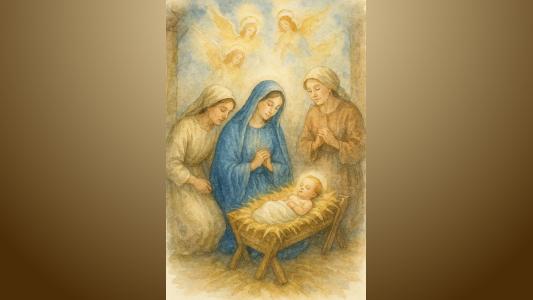
“122:8.1 (1351.5) All that night Mary was restless so that neither of them slept much. By the break of day the pangs of childbirth were well in evidence, and at noon, August 21, 7 b.c., with the help and kind ministrations of women fellow travelers, Mary was delivered of a male child. Jesus of Nazareth was born into the world, was wrapped in the clothes which Mary had brought along for such a possible contingency, and laid in a near-by manger.
122:8.2 (1351.6) In just the same manner as all babies before that day and since have come into the world, the promised child was born; and on the eighth day, according to the Jewish practice, he was circumcised and formally named Joshua (Jesus).
122:8.3 (1351.7) The next day after the birth of Jesus, Joseph made his enrollment. Meeting a man they had talked with two nights previously at Jericho, Joseph was taken by him to a well-to-do friend who had a room at the inn, and who said he would gladly exchange quarters with the Nazareth couple. That afternoon they moved up to the inn, where they lived for almost three weeks until they found lodgings in the home of a distant relative of Joseph.”
This is a quote from The Urantia Book describing the birth of Jesus in Bethlehem during the census for which Joseph and Mary had traveled. As can be seen, the birth date of Jesus Christ presented here does not match the generally accepted date of his birth. This date differs both in the year and the day.
Let’s read another excerpt from The Urantia Book placing this event in historical context:
“122:7.1 (1350.3) In the month of March, 8 b.c. (the month Joseph and Mary were married), Caesar Augustus decreed that all inhabitants of the Roman Empire should be numbered, that a census should be made which could be used for effecting better taxation. The Jews had always been greatly prejudiced against any attempt to “number the people,” and this, in connection with the serious domestic difficulties of Herod, King of Judea, had conspired to cause the postponement of the taking of this census in the Jewish kingdom for one year. Throughout all the Roman Empire this census was registered in the year 8 b.c., except in the Palestinian kingdom of Herod, where it was taken in 7 b.c., one year later.”
https://www.urantia.org/urantia-book-standardized/paper-122-birth-and-infancy-jesus
The Birth of Jesus According to Historical Sources
There are only a few historical sources mentioning the birth of Jesus, and none give the exact date. The most important texts from which Jesus’s birth date can be inferred are the Gospels of Matthew and Luke. Both the Gospel of Matthew and the Gospel of Luke state that Jesus was born during the reign of Herod the Great. Flavius Josephus, the most important historian of that era, recorded the king’s death shortly after a lunar eclipse and just before the Passover festival in 4 BC. There is no doubt about the date of Herod’s death – all historical sources agree on this date. Therefore, Jesus must have been born earlier.
The Gospel of Luke, however, mentions a general census under Quirinius. Tertullian, one of the early Christian writers (turn of the 2nd/3rd century AD), specified that the census took place under the governor Sentius Saturninus (9–6 BC). Luke may have mentioned Quirinius as a well-known figure who at that time served as an extraordinary imperial legate overseeing the registration.
https://en.wikipedia.org/wiki/Census_of_Quirinius
According to historical sources, Emperor Augustus conducted three major censuses of Roman citizens:
- 28 BC
- 8 BC
- 14 AD
The census of 8 BC is often cited as a potential reason for the Empire ordering registration in allied countries as well, which could have taken several years and, according to historical sources, reached Judea around 7 BC. This census might have occurred in Herod’s kingdom under the name “Universal Registration,” “Saturninus’s Census,” or “Bureaucratized Oath of Allegiance.” This event and this date fit best with the description in The Urantia Book.
https://www.comereason.org/roman-census.asp
https://christianity.stackexchange.com/questions/42003/what-indication-is-there-that-the-famous-census-under-quirinius-is-the-first-eve
Tertullian referred to this event. He claimed in his writings that the census at which Jesus was born was conducted under the governor of Syria, Sentius Saturninus. He held this office from 9–6 BC, which perfectly coincides with the lifetime of Herod the Great.
https://mateusz.pl/pow/020525.htm
https://digitalcommons.liberty.edu/cgi/viewcontent.cgi?article=1072&context=sor_fac_pubs
The system of counting years from the birth of Christ (AD) was introduced in the 6th century by the monk Dionysius Exiguus. He made an error in his calculations of about 4–7 years, mistakenly interpreting the reign dates of the Roman emperors and omitting the year zero.
https://en.wikipedia.org/wiki/Common_Era
The Birth of Jesus According to Christian Tradition
For this reason, the officially accepted birth date of Jesus is simply incorrect. Jesus could not have been born in the year 0, because at that time King Herod was already dead. Catholics symbolically celebrate Jesus’s birth on December 25th, while Orthodox Christians celebrate it on January 7th. Already here, in Christian traditions, there is an inconsistency. According to the Quran, Jesus was born in summer, not winter. The winter birth date of Jesus may have resulted from the adaptation of early Christianity to the cult of Mithras, popular at that time in the Near East and the Roman Empire. In Mithraism, the date of December 25th was important due to the birthday of the god Mithras and the winter solstice. The new religion took over the holidays of the old religion.
https://apologetyka.katolik.pl/jezus-jako-mitra-czyli-kult-mitry-a-chrzescijanstwo/
Summary
According to The Urantia Book, Jesus was born on August 21st in 7 BC. Based on the historical evidence cited above, it is probable that a census actually occurred in Judea in that year, for which Joseph and Mary traveled to Bethlehem.
The birth date is not so important, because the most important thing is the teaching of Jesus of Nazareth. Jesus did not want to create a cult around his person, which is why his disciples did not elaborate on his birth, but he wanted his teachings to spread. However, I believe that a lack of precision and the introduction of excessive symbolism does not serve his mission. On the contrary – deviating from historical facts leads to the mythologization of this great teacher and distracts from the truths he proclaimed.
I greet you! Until next time!
Video link:
https://youtube.com/shorts/BNVvgJDDxS8?si=gjIGGLxd2hAByeNq